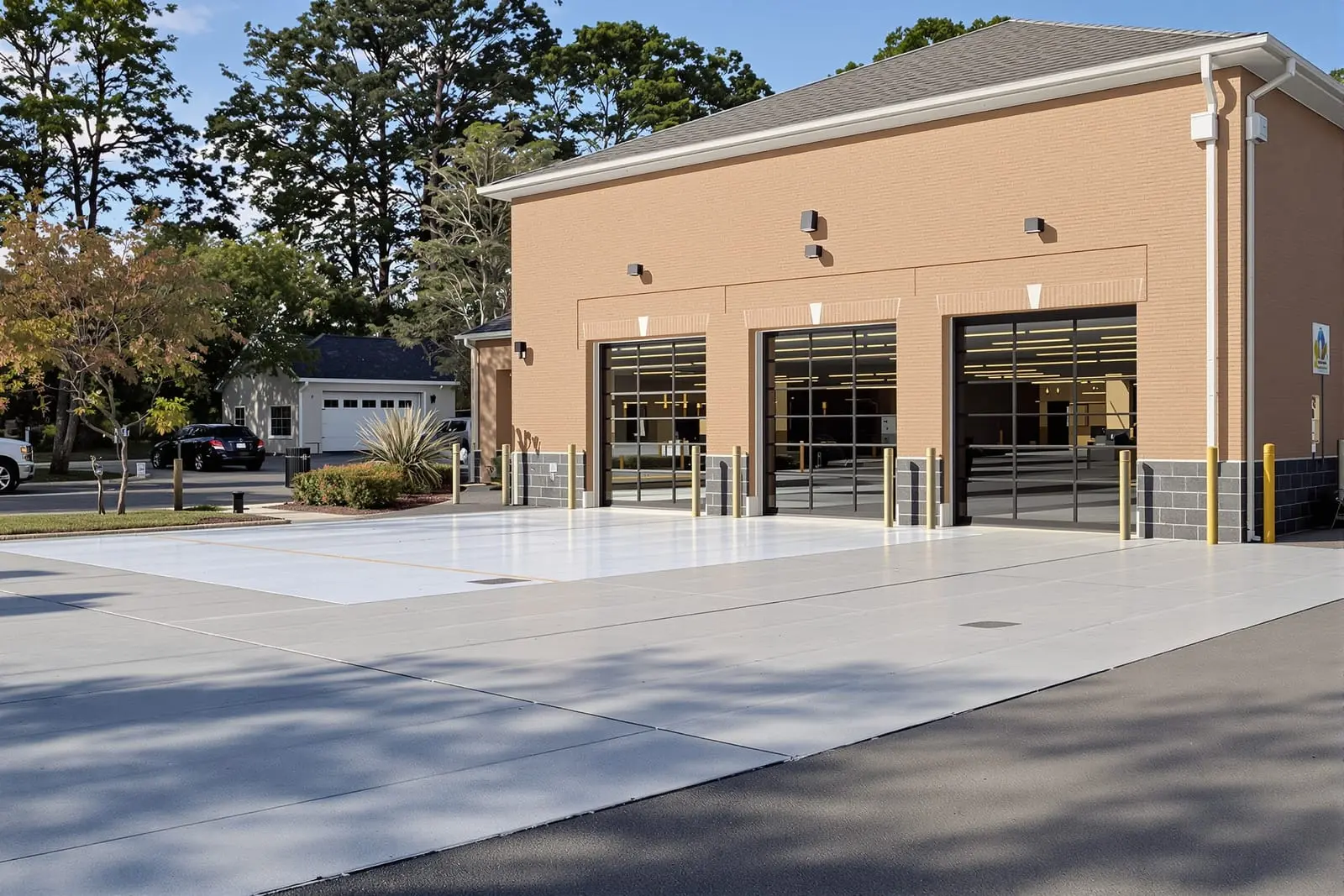
Handle heavy loads with confidence using a properly designed commercial concrete slab in Fort Wayne, IN. We construct loading docks, dumpster pads, equipment slabs, and service yards tailored to your operations. Our team considers truck weights, edge protection, and drainage to keep your site functional and safe. Count on our concrete contractor expertise for slabs built to perform under demanding conditions.
Primetime Concrete Fort Wayne provides professional commercial concrete slab throughout Fort Wayne, IN and the surrounding area. Our licensed, insured crew delivers safe, clean, on-time work with a free estimate before anything begins. Call (260) 888-3657 or request your free quote.
Engineered Loading Docks & Commercial Slabs in Fort Wayne
Primetime Concrete Fort Wayne designs and pours commercial concrete slabs and loading docks that are built around how your operation actually works, not just what is easiest to pour. Whether you are receiving semis at a distribution warehouse near the I-69 corridor or loading box trucks at a smaller shop off Coliseum Boulevard, the slab and dock details determine how smoothly and safely you can move freight.
We focus on load requirements, traffic patterns, and Fort Wayne soil and freeze conditions before we quote anything. Forklifts running 24/7, pallet jacks crossing thresholds, dock levelers cycling all day, and semi trailers backing in during winter all create specific stresses in the concrete. Our teams plan thickness, reinforcement, joint layout, and finishes so you do not end up with curled slabs, broken edges, or ponding water at the dock face.
Because we work almost exclusively in the Fort Wayne area, we know how our clay-heavy soils, freezing temps, and deicing salts affect commercial slabs, exterior aprons, and recessed loading pits. That local experience shapes the mix design, subgrade prep, and drainage we recommend for every job.
How We Design a Commercial Concrete Slab for Your Operation
A commercial concrete slab is never one size fits all. At Primetime Concrete Fort Wayne, we start with the loads. We look at forklift size and tire type, rack layout, point loads from columns and storage, and whether the slab will support trucks, dock equipment, or machinery. Based on that, we typically design slabs in the 6 to 10 inch range for interior floors and 8 to 12 inches for loading areas and exterior aprons, adjusting thickness and reinforcement where the loads are highest.
Next we evaluate the subgrade. In many parts of Fort Wayne and Allen County, we encounter expansive clays and soft spots that need proof rolling, moisture conditioning, and compacted aggregate base. We often specify 4 to 8 inches of compacted stone, sometimes more under loading docks and dumpster pads, to prevent settlement and slab rocking.
Reinforcement is chosen to match your needs and budget. Options include rebar mats, dowel baskets at joints, and heavy duty welded wire reinforcement. In high traffic loading zones, we frequently use #4 or #5 rebar on tighter spacing and install doweled construction joints to keep adjoining panels level. For joints, we plan spacing to control shrinkage cracking, then seal those joints in areas with constant forklift traffic to reduce spalling and maintenance issues.
Loading Dock Construction Details That Prevent Costly Failures
Loading docks have unique details that make or break their lifespan. We start by deciding whether you need a raised dock for semi trailers, a depressed dock, or a grade level dock with a dock leveler or edge-of-dock plate. We coordinate dock elevations with your building openings and typical trailer heights so your equipment works correctly without constant adjustments.
The dock face and exterior approach are critical. At Fort Wayne sites where semis back in repeatedly, we thicken the edge of the slab and use heavy reinforcement so trailer impact and wheel loads do not break the concrete nose. We also install steel angle or embedded curb in some cases to protect corners from repeated trailer contact.
Drainage is another common failure point for local docks. Ice buildup from roof runoff or snow melt in winter can shut down your operation. To avoid this, we pitch exterior slabs away from the building, add trench drains or area drains where needed, and tie those into your storm system. On interior dock slabs and pits, we pay special attention to vapor barriers, insulation, and sealing around dock levelers to limit condensation and corrosion in Fort Wayne’s freeze and thaw cycles.
Step by Step: Our Commercial Slab & Dock Installation Process
Once design details are set, Primetime Concrete Fort Wayne follows a repeatable process to keep your project on schedule and within spec.
1) Layout and excavation. We establish elevations using lasers so finished slab heights align with existing floors, door thresholds, and dock equipment. Excavation removes unsuitable soil and creates room for base stone and any thickened edge beams.
2) Subgrade and base prep. We compact native soil where feasible, then install and compact crushed stone to the specified depth. Soft areas are undercut and replaced so you are not pouring a thick slab over a weak spot that will settle later.
3) Forms and reinforcement. We set forms to the correct slopes and elevations, then install rebar, welded wire, dowel baskets, and slab dowels into existing concrete. At loading docks we reinforce the dock face, dock pit walls, and any equipment pockets according to the engineered plan.
4) Concrete placement. We typically use a 4,000 to 5,000 psi air-entrained commercial mix for Fort Wayne exterior slabs, with admixtures to handle placement in our variable weather. For interior floors, we may adjust mixes for lower shrinkage and better flatness if you have racking, narrow aisle forklifts, or sensitive equipment.
5) Finishing and curing. Loading dock slabs and high traffic zones usually receive a broom or light texture finish for traction, with troweled surfaces inside where smoothness is needed. We cut or saw control joints at planned locations and apply curing compounds or wet curing methods to reduce shrinkage cracking and surface dusting.
6) Final detailing. For docks this can include installing dock bumpers, setting anchor bolts or plates, and sealing joints and slab penetrations. We walk the slab with you to check elevations, slopes, and flatness before we demobilize.
Cost Drivers for Commercial Concrete Slabs and Docks in Fort Wayne
Owners and facility managers often ask why numbers can vary so much between quotes. The biggest cost driver is thickness and reinforcement. A 6 inch lightly reinforced interior slab will cost far less than a 10 inch heavily reinforced loading area designed for semis and heavy forklifts. The right design prevents underbuilding, which can lead to slab failure and expensive downtime.
Site conditions are next. Poor access, tight downtown sites, or working inside an active facility near Lima Road can increase labor time and pump truck usage. Soft soils, existing buried utilities, or the need to sawcut and remove old slabs will also add cost.
Finishing requirements matter too. Super-flat floors for high-bay warehousing require more labor, testing, and sometimes different mixes compared with a standard broom finish truck court. Heated slabs, vapor mitigation systems, or chemical resistant sealers for food or manufacturing facilities in Fort Wayne are additional line items.
Finally, schedule affects price. Night or weekend pours, phased work around ongoing operations, or fast-track timelines where we must mobilize larger crews or add extra equipment can influence the overall cost. We lay these factors out clearly so you understand exactly what you are paying for and why.
Common Slab and Dock Problems We See Locally (and How We Prevent Them)
Because we routinely repair failed slabs and docks across Fort Wayne, we know the most common mistakes worth avoiding. One issue is inadequate subgrade prep. When the base is not compacted properly or wet spots are ignored, slabs settle, curl, or crack severely at docks and thresholds. Our crews proof roll and inspect before pouring so these weak zones are corrected.
Another frequent problem is joint layout that does not match traffic patterns. Forklifts crossing poorly placed joints or dock plates that land right on a joint can hammer the edges until they spall. We design joint locations to keep the heaviest traffic away from slab corners and use dowels and joint sealants appropriate for your traffic level.
In exterior loading zones, we see frost heave and surface scaling where the wrong concrete mix or curing method was used. Fort Wayne winters and deicing salts are hard on concrete. We use air-entrained mixes, proper curing, and, when appropriate, sealers that stand up to salt to keep your investment performing for years.
At docks installed without proper pitch or drainage, we see chronic puddles and ice. Our solution is simple but critical: accurate laser grading, minimum slopes away from the building, and correctly sized drains connected to working storm lines. Addressing these details in the design stage is much cheaper than grinding or re-pouring later.
Why Fort Wayne Businesses Choose Primetime Concrete Fort Wayne
For loading docks and commercial concrete slabs, Fort Wayne companies rely on partners that understand operations, not just concrete. Primetime Concrete Fort Wayne coordinates with your GC, dock equipment supplier, and racking or machinery installers so slab thickness, elevations, anchor locations, and joint layouts all work together. That coordination reduces surprises and costly rework when it is time to move in.
We are used to working around live facilities, which means planning pours to minimize downtime. For example, when upgrading an older dock near New Haven or increasing slab thickness in an active warehouse off Airport Expressway, we phase the work so part of your dock line or warehouse remains usable while we demo and repour the rest.
Our team is based here, so we are available for follow up if you need later modifications, such as cutting in new trench drains, thickening a dock approach for heavier trucks, or extending a commercial slab for an addition or new equipment pad. We treat each project as a long term asset for your business and build it accordingly.
If you are planning new construction or upgrades to loading docks and commercial slabs anywhere in the Fort Wayne area, we can review your plans, walk your site, and provide specific recommendations before you commit to a design. That early input often saves our clients both money and future headaches.
“
Professional loading docks & commercial slabs, done right the first time, quality materials, honest pricing, and results that last.
Primetime Concrete Fort Wayne
Loading Docks & Commercial Slabs Across Our Service Area